“Of all the fallacies of irrelevance, the argument against the person, or ad hominem, is among the most pernicious.” - Irving M. Copi, Carl Cohen, and Kenneth McMahon, Introduction to Logic, 14th Edition, 2014, 118.
Etymology:
- The Latin term “ad hominem” translates to “to the person.”
Definition:
- When a person attacks the proponent during an argument instead of the argument itself, it’s called the Ad Hominem Fallacy.
- An attack done to the person during this fallacy is called an Ad Hominem Attack.
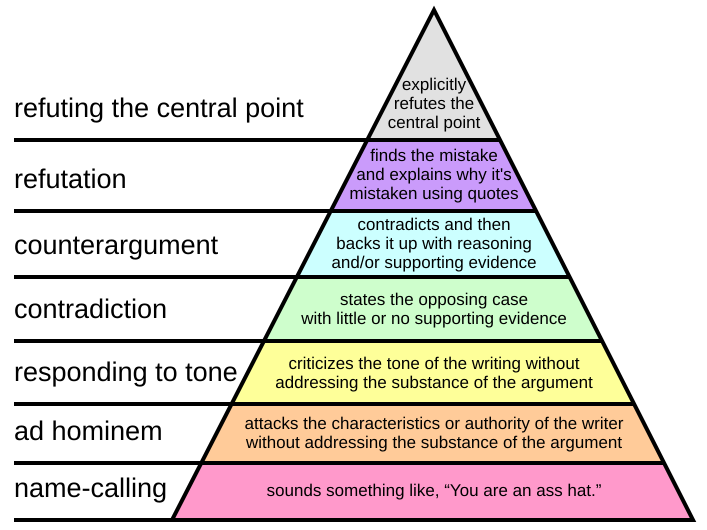
Graham's Hierarchy of Disagreement
Details:
The fallacy in topic is Ad Hominem/Against the person/To the person Fallacy. It is an informal fallacy. It’s one of the most common fallacies, especially in Bangladesh. Instead of arguing constructively, people prefer to engage in insulting each other. This is, as you can expect, objectively illogical. An Ad Hominem attack doesn’t address the argument itself; it merely distracts from the issue.
Types of Ad Hominem:
-
Abusive Ad Hominem: Straight-up insults/swearing/name-calling.
- Example:
- X: “These three issues need to be fixed for our country’s development.”
- Y: “You are just stupid and evil!”
- Counters:
- Ignoring: This is often the best strategy. Do not lower yourself to their level by responding with insults.
- Refocusing: “Please focus on the issue instead of personal insults.”
- Example:
-
Circumstantial Ad Hominem: Questioning the validity or motive of the proponent.
- Example:
- X: “Our country needs to get rid of problematic traditions.”
- Y: “You are too young to make that statement!”
- Counters:
- Address the Argument: “My age does not determine my ability to comment on this issue.”
- Appeal to Credibility (if possible): “As someone who has studied this issue for X years, I believe…”
- Example:
-
Tu Quoque (You too): Attempts to call out the proponent on hypocrisy.
- Example:
- X: “Fast foods are very unhealthy.”
- Y: “But you eat burgers every day.”
- (Here, X is a hypocrite because their actions contradict their argument, and Y tries to refute X’s argument by pointing out this hypocrisy. But this does not mean X is wrong.)
- Counters:
- Address the Argument: “That may be true, but it doesn’t change the fact that…”
- Acknowledge and Explain (if applicable): “You have a point, but I’m working on changing my habits. However, the issue of…”
- Example:
-
Guilt by Association: Attempt to discredit the argument by associating them with a negative group or ideology.
- Example:
- X: “We need to impose stricter gun control laws.”
- Y: “Are you a criminal? You are because you want to take our guns away.”
- Counters:
- Disassociate the Argument from the Group: “My argument is based on logic, not affiliation with any group. Let’s focus on the actual reasons I believe…”
- Highlight the Flaw: “That tactic is called ‘guilt by association’ and it’s a logical fallacy. The real issue is…”
- Example:
Why?
Why is it a fallacy?
Why is it a fallacy? I think it’s pretty self-explanatory. Nothing good comes out of it; instead, people get hurt and no debate is properly resolved.
Why would someone do this?
The main objective behind this fallacy is to either devalue the proponent’s argument or dismiss it completely. It is typically used as a Red Herring (Distraction). It might distract the proponent, but it doesn’t refute their argument.
Respecting the Opponent
We mustn’t disrespect our opponent because not only does it show that we might be immature, it also shows that we do not have proper points to use against them. In real life, it is basic etiquette to show basic human respect. We should always respect our opponent to a certain degree. However, exceptions might be considered in cases involving fake online IDs. If an opponent does not engage respectfully by using their real ID, it may be appropriate to take them less seriously. This, however, is different from discrediting their argument altogether.
When is it Fair to Use Ad Hominem?
Almost never, but certain exceptions do exist. If the opponent keeps continuously swearing at you, you have the right to swear back at them. But I do not recommend it as it would lower you to their level and swearing is not productive anyways. It might be acceptable when the opponent deliberately annoys you using illogic and fallacies. If the opponent straight up doesn’t argue with you or debate properly, only asserts claims as fact, labeling them as “stupid” might be appropriate. These are justified responses, but none of them are recommended. Do not lower yourself to the level of people you dislike.